
Home Addition vs. ADU in Southern California: Which Adds More Value?

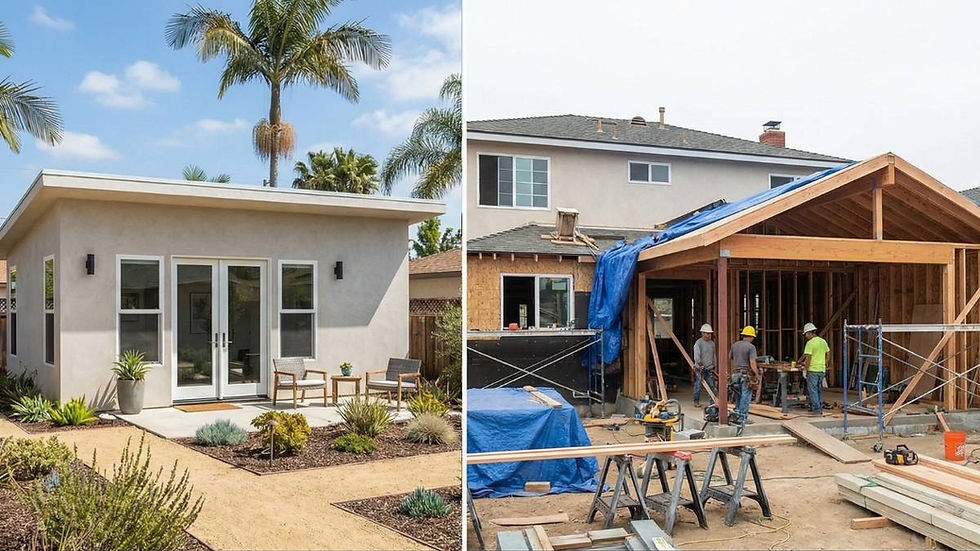
Should you build an ADU in your backyard or add a room to your existing home? Southern California homeowners ask us this question constantly, and the honest answer is: it depends on YOUR goals. As a design-build company that constructs both ADUs and home additions throughout Los Angeles, Orange, Riverside and Ventura Counties, Dynamic Quality Builders (DQB) is uniquely positioned to give you unbiased guidance. This comprehensive comparison covers costs, timelines, permits, property value, rental income potential, and a decision framework to help you choose the right option.
Quick Comparison: ADU vs. Home Addition at a Glance
Factor | ADU | Home Addition |
Cost Range | $150,000-$350,000+ | $75,000-$200,000+ |
Cost Per Sq Ft | $300-$500+ | $250-$400 |
Permit Timeline | 2-4 months (streamlined) | 3-6+ months (discretionary) |
Construction Time | 3-6 months | 3-6 months |
Total Timeline | 6-10 months | 8-14 months |
Rental Income | $1,800-$3,500/month | Not separately rentable |
Property Value Impact | +25-35% | Varies by square footage |
Financing | Equity-based (HELOC, equity loan) | Equity-based (same options) |
Best For | Rental income, multi-gen privacy | Family space, integrated living |
Is It Cheaper to Build an ADU or Add an Addition in California?
Home additions typically cost less per square foot ($250-$400) than ADUs ($300-$500+) because additions share existing home systems like plumbing, electrical, and HVAC. However, ADUs can generate $1,800-$3,500 per month in rental income, which often pays for the project over time. In Southern California, a master suite addition runs $100,000-$200,000, while a comparable-size detached ADU costs $180,000-$300,000.
The cost difference comes down to one key factor: ADUs require complete, independent systems while additions share existing infrastructure.
Why Additions Cost Less Per Square Foot:
Additions tie into existing plumbing lines ($5,000-$12,000 vs. $15,000-$25,000 for new ADU systems)
Additions expand existing electrical panels rather than requiring new service
HVAC can often be extended from existing system ($5,000-$10,000 vs. $8,000-$15,000 for separate ADU system)
No separate kitchen required (saves $15,000-$30,000)
Shares foundation with existing home in many cases
Why ADUs Cost More Per Square Foot:
Must have independent kitchen ($15,000-$30,000)
Requires full bathroom ($10,000-$20,000)
Separate electrical panel and service
Independent plumbing connections
Separate HVAC system
Own foundation (detached ADUs)
Separate utility meters in many jurisdictions
Cost Comparison by Project Type:
Project Type | Size | Total Cost | Cost/Sq Ft |
Single Room Addition | 200-400 sf | $50,000-$100,000 | $250-$350 |
Master Suite Addition | 400-600 sf | $100,000-$200,000 | $300-$400 |
Second Story Addition | 500-1,000 sf | $150,000-$350,000 | $350-$450 |
Garage Conversion ADU | 400-600 sf | $120,000-$180,000 | $300-$400 |
Detached ADU | 500-800 sf | $180,000-$350,000 | $350-$500 |
The Bottom Line: If upfront cost is your only concern, additions are typically cheaper. But if you factor in rental income potential, ADUs often provide better long-term financial returns.
Key Takeaways:
Additions cost less upfront because they share existing systems
ADUs cost more but can generate $20,000-$40,000+ annually in rent
For pure cost efficiency, additions win; for ROI, ADUs often win
Both can be financed through home equity with DQB's zero-payment construction model
Does an ADU or Home Addition Add More Value to a California Property?
Both ADUs and home additions increase property value, but in different ways. ADUs typically add 25-35% to property value in high-demand Southern California markets, with some LA properties seeing increases of 50% or more. Additions add value based on increased living square footage, typically recovering 50-80% of construction costs in immediate equity. The key difference: ADUs are valued as income-producing assets, while additions are valued as enhanced primary residence space.
How ADUs Add Value:
ADUs create value through two mechanisms: increased square footage AND rental income potential.
When appraisers evaluate a property with an ADU, they consider:
The physical structure's replacement cost
Comparable sales of homes with ADUs
Capitalized rental income (income approach)
In Los Angeles County, where housing demand far exceeds supply, ADUs command a premium. A 600-square-foot ADU generating $2,800/month in rent can add $150,000-$200,000+ to property value because buyers see both the space and the income stream.
ADU Property Value Impact by County:
County | Typical ADU Value Increase | Why |
Los Angeles | +25-50% | Extreme housing demand, high rents |
Orange County | +25-40% | Affluent buyers value rental income |
Riverside | +20-30% | Growing market, affordability focus |
Ventura | +25-35% | Coastal premium, limited inventory |
How Additions Add Value:
Home additions add value through increased living square footage. Appraisers calculate value based on your neighborhood's price per square foot.
Example:
Your neighborhood averages $500/sq ft for finished space
You add a 500 sq ft master suite costing $175,000
Theoretical value increase: 500 × $500 = $250,000
Realistic value increase: $125,000-$200,000 (50-80% of theoretical)
Additions rarely recoup 100% of costs immediately because buyers discount for the disruption factor and personal taste differences in finishes.
Which Adds More Value? It Depends:
Your Situation | Better Choice | Why |
High-rent market (LA, coastal OC) | ADU | Income stream commands premium |
Family-oriented suburb | Addition | Buyers value integrated space |
Planning to sell in 1-2 years | Addition | Immediate equity, no landlord hassle |
Planning to hold 5+ years | ADU | Rental income + appreciation |
Multi-generational living planned | ADU | Privacy commands premium to buyers |
Key Takeaways:
ADUs add 25-35% to property value in Southern California (higher in LA)
Additions recover 50-80% of construction cost in immediate equity
ADUs are valued as income-producing assets; additions as living space
Long-term hold: ADU typically wins. Short-term sale: Addition may be simpler
Is It Easier to Get Permits for an ADU or a Home Addition in California?
Quick Answer: ADUs generally have easier, faster permitting thanks to California state laws (AB 68, AB 881, SB 13) that streamlined the approval process and limited local government barriers. State law requires cities to approve compliant ADU applications within 60 days. Traditional home additions are subject to full local discretionary review, which can include design review boards, variance requests, and neighbor notification, adding months to the process.
Why ADU Permits Are Easier:
California passed aggressive ADU legislation specifically to increase housing supply. These laws preempt local restrictions:
60-Day Mandate: Cities must approve or deny ADU applications within 60 days (or the permit is automatically approved)
Ministerial Approval: ADUs that meet objective standards cannot be denied at local discretion
Reduced Setbacks: State law allows 4-foot rear and side setbacks for ADUs under 16 feet tall
No Parking Requirements: Most ADUs are exempt from parking requirements
No Owner-Occupancy: You don't have to live on the property to build an ADU
Why Addition Permits Take Longer:
Traditional room additions face full discretionary review:
Design Review: Many cities require additions to match existing architecture, which means a subjective review
Variance Requests: If your addition doesn't meet setbacks or lot coverage, you need approval that can take months
Neighbor Notification: Many cities notify neighbors of addition projects, opening potential objections
Environmental Review: Larger additions may trigger CEQA review in some jurisdictions
Plan Check Complexity: Additions that modify existing structure require detailed engineering review
Permit Timeline Comparison:
Process Stage | ADU | Addition |
Plan preparation | 4-8 weeks | 4-8 weeks |
Initial plan check | 2-4 weeks | 4-8 weeks |
Revisions | 2-4 weeks | 4-8 weeks |
Final approval | 1-2 weeks | 2-4 weeks |
Total | 2-4 months | 3-6+ months |
County-Specific Permit Timelines:
County | ADU Permits | Addition Permits |
Los Angeles (City) | 8-12 weeks | 12-20+ weeks |
Los Angeles (Unincorporated) | 6-10 weeks | 10-16 weeks |
Orange County (varies by city) | 6-10 weeks | 10-18 weeks |
Riverside County | 4-8 weeks | 8-14 weeks |
Ventura County | 6-10 weeks | 10-16 weeks |
Key Takeaways:
ADU permits are streamlined by California state law with 60-day approval mandate
Addition permits face full discretionary review with potential for delays
ADU permits: 2-4 months typical; Addition permits: 3-6+ months typical
Riverside County has fastest permits; LA City has most complexity for both
How Long Does It Take to Build an ADU vs. a Home Addition?
Construction timelines are similar for both ADUs and additions, typically 3-6 months once permits are approved. However, ADUs usually have faster overall project timelines (6-10 months total) compared to additions (8-14 months total) because ADU permitting is more streamlined. The construction phase depends on project complexity, site conditions, and whether you're doing a garage conversion, attached addition, or new detached structure.
Construction Phase Breakdown:
Phase | ADU (Detached) | ADU (Garage Conv.) | Addition |
Site prep/Demo | 1-2 weeks | 1-2 weeks | 1-2 weeks |
Foundation | 2-4 weeks | 1-2 weeks | 1-3 weeks |
Framing | 2-4 weeks | 2-3 weeks | 2-4 weeks |
Roofing | 1-2 weeks | 0-1 week | 1-2 weeks |
Rough plumbing/electrical | 2-3 weeks | 2-3 weeks | 1-2 weeks |
Insulation/Drywall | 2-3 weeks | 2-3 weeks | 2-3 weeks |
Finish work | 4-6 weeks | 3-5 weeks | 4-6 weeks |
Total Construction | 14-24 weeks | 11-19 weeks | 12-22 weeks |
Total Project Timeline (Design to Keys):
Project Type | Design/Plans | Permits | Construction | Total |
Garage Conversion ADU | 4-6 weeks | 8-12 weeks | 3-5 months | 6-9 months |
Detached ADU | 6-10 weeks | 8-14 weeks | 4-6 months | 7-11 months |
Room Addition | 4-8 weeks | 12-20 weeks | 3-5 months | 8-12 months |
Master Suite Addition | 6-10 weeks | 12-20 weeks | 4-6 months | 9-13 months |
Second Story Addition | 8-12 weeks | 14-24 weeks | 5-7 months | 11-16 months |
DQB Average Timelines:
Garage Conversion ADU: 7-9 months from contract to keys
Detached ADU: 8-10 months
Room/Suite Addition: 9-12 months
Second Story Addition: 12-15 months
Factors That Extend Timeline:
Complex engineering requirements (hillside, soil issues)
Custom architectural design
City-specific permit delays
Material lead times for special finishes
Weather delays during rainy season
Inspection scheduling backlogs
Key Takeaways:
Construction is similar: 3-6 months for most projects
ADU total timeline (6-10 months) beats additions (8-14 months) due to faster permits
Garage conversions are fastest overall (6-9 months)
Second-story additions take longest (11-16 months)
Can I Rent Out a Home Addition Like I Can Rent an ADU?
No, traditional home additions cannot be rented as separate units. ADUs are specifically designed as independent, rentable living spaces with separate entrances, full kitchens, and bathrooms, meeting California's legal definition of a dwelling unit. Additions become part of your primary residence and cannot legally be rented as standalone apartments. This is the fundamental difference that drives the ADU vs. addition decision for many homeowners.
What Makes an ADU Rentable:
California law defines ADUs as complete, independent dwelling units that must include:
Separate exterior entrance (not through main house)
Full kitchen with cooking appliances
Full bathroom
Living/sleeping area
Independent heating/cooling capability
Because ADUs meet these requirements, they can be legally rented as separate units with their own lease agreements.
Why Additions Can't Be Rented Separately:
A traditional room addition, even with a bathroom, becomes part of your primary residence. It typically:
Connects to main house through interior doorways
Shares kitchen with main house
Doesn't have independent entrance (or if it does, lacks kitchen)
Is counted as additional bedrooms/square footage of your home
You cannot sign a separate lease for a room addition. You could rent rooms within your home (house hacking), but that's different from having an independent rental unit.
Rental Income Comparison:
County | ADU Rental Income | Addition Rental Income |
Los Angeles | $2,500-$3,500/month | $0 (not rentable) |
Orange County | $2,800-$3,800/month | $0 |
Riverside | $1,800-$2,500/month | $0 |
Ventura | $2,200-$3,000/month | $0 |
Can I Convert My Addition to an ADU Later?
Yes, but it requires a new permit process. You'd need to:
Add a separate exterior entrance
Install a full kitchen
Ensure separate bathroom access
Meet all ADU setback and parking requirements
Pay new permit fees ($10,000-$20,000)
Modify construction to meet current codes
This is expensive and time-consuming. If rental income is a possibility, build an ADU from the start.
Key Takeaways:
ADUs can be rented legally as independent units ($1,800-$3,800/month in SoCal)
Additions become part of your home and cannot be separately rented
This is the single biggest difference between ADUs and additions
If rental income matters to you, even as a future possibility, choose ADU
When Should I Build an ADU vs. a Home Addition?
Build an ADU if you want rental income, multi-generational housing with privacy, or maximum future flexibility. Build an addition if you need integrated family space, prefer one unified household, or have lot constraints that prevent a detached structure. Your primary goal, income vs. space, usually determines the right choice.
Choose an ADU When:
Rental income is a goal: Even if you don't plan to rent immediately, ADU preserves the option
Housing family who wants privacy: Aging parents or adult children often prefer separate entrance and kitchen
You want a separate guest suite: ADU offers hotel-level privacy for visitors
Your property has adequate lot space: Room for detached structure or attached ADU above garage
Long-term investment matters: ADU provides ongoing income + property value increase
Multi-generational living with independence: Family nearby but not under same roof
Choose an Addition When:
You need more bedrooms/bathrooms connected to main home: Growing family, home office
You prefer one integrated household: Young children, shared family dinners
Your lot limits detached construction: Small lot, setback issues, no rear yard access
You want lower upfront cost: Addition typically costs less than equivalent ADU
Rental income isn't important: You'll never rent the space
Planning to sell soon: Addition is simpler for resale (no landlord concerns)
Decision Matrix:
Your Priority | Best Choice | Why |
Rental income | ADU | Only option that can be legally rented |
Monthly cash flow | ADU | Generates $1,800-$3,800/month |
Family living space | Addition | Integrated, shared household |
Aging parent privacy | ADU | Separate entrance, kitchen, independence |
Adult child housing | ADU or Addition | ADU if they want privacy; addition if close integration |
Lower upfront cost | Addition | Shares existing systems |
Better long-term ROI | ADU | Rental income + property value |
Faster permit process | ADU | Streamlined by state law |
Minimal lot impact | Addition | Expands existing footprint |
Future flexibility | ADU | Can rent, use for family, or sell (AB 1033) |
Key Takeaways:
ADU = rental income, privacy, flexibility, long-term ROI
Addition = integrated family space, lower upfront cost, simpler household
If rental income is even a future possibility, ADU is usually smarter
DQB builds both, we help you choose what fits YOUR goals, not push one option
How Do I Finance an ADU vs. a Home Addition?
Both ADUs and additions can be financed through home equity using a HELOC (Home Equity Line of Credit) or second mortgage. You'll need 40-50% equity in your home to qualify. The financing process is virtually identical for both project types. Dynamic Quality Builders covers your loan payments during construction for either project type.
Financing Options for Both:
Financing Type | ADU | Addition | Notes |
HELOC | Yes | Yes | Variable rate, draw as needed |
Home Equity Loan | Yes | Yes | Fixed rate, lump sum |
Cash-Out Refinance | Yes | Yes | Replace existing mortgage |
Construction Loan | Yes | Yes | Based on after-completion value |
Equity Requirements:
For both ADUs and additions, you typically need:
40-50% equity in your home
Credit score of 620+ (580+ with strong equity)
Debt-to-income ratio under 43-45%
Stable income documentation
DQB's Payment Coverage Model:
Whether you build an ADU or addition, DQB covers your loan payments during the 3-6 month construction period:
You secure financing through HELOC or home equity loan
During construction, DQB makes your monthly payments (typically $1,100-$1,700)
Covered payments ($6,000-$12,000 total) are added to final project cost
You start paying only after receiving keys
For ADUs: rental income often covers payment from day one
For additions: you've preserved cash during construction
A Note on ADU Grants:
California previously offered the CalHFA ADU Grant Program ($40,000 for pre-development costs), but as of early 2026, this program is not accepting new applications, and previous funding rounds have been fully allocated. While some local jurisdictions occasionally offer limited ADU incentive programs with strict income-based restrictions, most homeowners should plan to finance the full project cost through home equity. DQB stays current on any new programs and will let you know if you qualify for assistance.
Monthly Payment Comparison:
Project | Cost | Loan Amount | Monthly Payment | Rental Income | Net Cash Flow |
Master Suite Addition | $175,000 | $180,000 | ~$1,570/month | $0 | -$1,570/month |
Detached ADU | $225,000 | $235,000 | ~$2,050/month | $2,800/month | +$750/month |
Garage Conversion ADU | $160,000 | $168,000 | ~$1,465/month | $2,500/month | +$1,035/month |
Key Takeaways:
Same financing options (HELOC, equity loan) work for both ADUs and additions
Plan to finance the full project, ADU grant programs are not currently accepting applications
DQB covers loan payments during construction for either project type
ADUs can generate positive cash flow; additions are pure expense
What Are Common Misconceptions About ADUs vs. Home Additions?
The biggest misconception is that California offers "free ADU grants" that pay for construction. While programs existed in the past, the CalHFA ADU Grant is not currently accepting applications as of 2026. Other myths include "ADUs are always cheaper" (they're not; additions often cost less per square foot), "addition permits are faster" (ADU permits are actually streamlined by state law), and "ADUs are always better investments" (it depends entirely on your goals and whether you'll actually rent the unit).
Misconception 1: "California Offers Free ADU Grants"
Reality: California's CalHFA ADU Grant Program ($40,000 for pre-development costs) is not currently accepting new applications; previous funding rounds have been fully allocated. Even when active, the grant only covered plans and permits, never construction costs. Most homeowners should plan to finance 100% of their ADU project through home equity. Some local programs exist but are rare, highly competitive, and typically income-restricted.
Misconception 2: "ADUs Are Always Cheaper Than Additions"
Reality: ADUs often cost MORE per square foot because they require independent systems:
Separate kitchen: $15,000-$30,000
Full independent plumbing: $15,000-$25,000
Separate electrical service: $10,000-$18,000
Own HVAC system: $8,000-$15,000
A 500 sq ft addition might cost $150,000. A 500 sq ft ADU might cost $200,000. The ADU can generate income, but it's not cheaper to build.
Misconception 3: "Addition Permits Are Faster Because They're Just Expanding the House"
Reality: ADU permits are faster thanks to California state laws (AB 68, AB 881, SB 13) that mandate 60-day approval timelines and limit local discretion. Addition permits face full discretionary review, design board approval, and potential neighbor objections. Typical ADU permits: 2-4 months. Typical addition permits: 3-6+ months.
Misconception 4: "ADUs Are Always Better Investments"
Reality: ADUs are better investments IF you actually rent them. If you build an ADU for family use and never rent it, you've paid more for a project that doesn't generate income. An addition that meets your family's needs for less money might be the smarter financial choice.
Misconception 5: "I Can Convert My Addition to an ADU Later"
Reality: Converting an addition to an ADU requires a new permit process, adding a separate entrance, installing a full kitchen, and meeting all current ADU codes. This costs $30,000-$50,000+ and takes months. If rental income is even a future possibility, build the ADU from the start.
Misconception 6: "ADU Permits Are Instant"
Reality: While ADU permits are streamlined, they still take 2-4 months for plan preparation, submittal, plan check, revisions, and approval. "Streamlined" doesn't mean "immediate."
Key Takeaways:
ADU grant programs are not currently active, plan to finance the full project
ADUs typically cost MORE upfront than comparable additions
ADU permits are actually FASTER due to state law streamlining
ADU ROI depends on actually renting the unit
Build ADU from start if rental income is even a future possibility
Real Homeowner Scenarios: Which Option Was Right?
Scenario 1: The Rental Income Seeker
Homeowner: Maria and Carlos, Riverside County
Goal: Generate income to help with retirement
Decision: Detached ADU
They built a 600 sq ft detached ADU for $195,000. Monthly rent: $2,200. After their $1,700/month loan payment, they net $500/month,$6,000/year in passive income. The ADU also added approximately $125,000 to their property value.
Why ADU was right: Rental income was the primary goal. An addition wouldn't generate any monthly income.
Scenario 2: The Growing Family
Homeowner: Jennifer and Mark, Orange County
Goal: Add bedroom and bathroom for third child
Decision: Master suite addition
They added a 450 sq ft master suite for $165,000, moving their older children into the previous master and creating a new nursery. The construction integrated seamlessly with their existing home.
Why addition was right: They needed connected family space, not a separate unit. Rental income wasn't a goal, and lower cost mattered.
Scenario 3: The Multi-Generational Family
Homeowner: David, Los Angeles County
Goal: Housing for aging mother who values independence
Decision: Attached ADU above garage
David built a 550 sq ft attached ADU above his garage for $235,000. His mother has her own entrance, kitchen, and living space while being close enough for daily family dinners. If circumstances change, the unit can be rented for an estimated $2,800/month.
Why ADU was right: His mother wanted privacy and independence, her own kitchen, entrance, and living room. An addition wouldn't provide that separation.
Scenario 4: The Future Planner
Homeowner: Rachel, Ventura County
Goal: Home office now, potential rental later
Decision: Detached ADU with office configuration
Rachel built a 500 sq ft ADU configured as a home office/studio for $210,000. She uses it for her graphic design business now, but it's fully permitted as an ADU with a kitchenette. When she retires, she can rent it for $2,400/month to supplement retirement income.
Why ADU was right: Even though she's not renting now, the ADU preserves future flexibility. An addition would lock her into residential-only use.
Frequently Asked Questions
Q: Is it cheaper to build an ADU or add an addition?
A: Additions typically cost less per square foot ($250-$400) than ADUs ($300-$500+) because additions share existing home systems. A 500 sq ft addition might cost $150,000, while a 500 sq ft ADU might cost $200,000. However, ADUs can generate $20,000-$40,000+ in annual rental income, making them potentially better long-term investments.
Q: Are there ADU grants available in California?
A: As of early 2026, California's main ADU grant program (CalHFA ADU Grant) is not accepting new applications; previous funding rounds have been fully allocated. When active, it only covered pre-development costs (plans, permits), not construction. Some local jurisdictions offer limited programs with strict income restrictions, but most homeowners should plan to finance the full project through home equity. DQB stays current on available programs and will advise if any apply to your situation.
Q: Does adding an ADU increase property taxes in California?
A: Yes, but only on the value of the new ADU construction, not your entire property. Thanks to Proposition 13, your existing home's assessed value remains protected. Only the ADU's value (typically $100,000-$200,000) is added to your tax base, increasing annual property taxes by approximately $1,000-$2,500.
Q: Can I convert my addition to an ADU later?
A: Yes, but it requires a new permit process, adding a separate exterior entrance, installing a full kitchen, and meeting all current ADU requirements. This typically costs $30,000-$50,000+ and takes several months. If rental income is even a future possibility, build an ADU from the start.
Q: How long does the ADU permit process take vs. an addition?
A: ADU permits typically take 2-4 months, thanks to California state laws requiring 60-day approval timelines. Addition permits take 3-6+ months because they face full discretionary review. ADU permitting is streamlined by law; addition permitting is not.
Q: Which adds more property value, an ADU or addition?
A: Both add significant value. ADUs typically add 25-35% to property value in Southern California because they're valued as income-producing assets. Additions add value based on increased square footage, typically recovering 50-80% of construction cost in immediate equity. Long-term, ADUs often provide better returns due to rental income.
Q: Can I rent out a home addition?
A: No, traditional home additions cannot be legally rented as separate units. They become part of your primary residence. Only ADUs, with separate entrances, kitchens, and bathrooms, can be rented as independent dwelling units.
Q: What is one drawback of an ADU?
A: The main drawback is landlord responsibility. If you rent your ADU, you'll manage tenants, handle maintenance requests, deal with potential vacancies, and navigate landlord-tenant law. Additions have no such responsibilities since they're part of your home.
Q: Do I need separate utility meters for an ADU?
A: Many jurisdictions require separate electric meters for ADUs; water and gas requirements vary by city. Separate meters make it easier to charge tenants for utilities but add installation costs ($2,000-$5,000). DQB handles utility planning as part of the permit process.
Q: Can I build an ADU and addition at the same time?
A: Yes, but both projects need separate permits. Combined projects require careful coordination for setbacks, lot coverage calculations, and utility planning. DQB can manage both simultaneously under one contract if both make sense for your property.
Q: Which is better for multi-generational housing?
A: ADUs are typically better for multi-generational housing because they provide complete independence,separate entrance, kitchen, bathroom, and living space. Additions work better when closer daily integration is preferred (young grandchildren, shared meals daily).
Q: What are common mistakes when building an ADU?
A: Common ADU mistakes include underestimating total costs, choosing poor lot placement (blocking views or yard access), skimping on soundproofing between units, not planning for parking, and assuming government grants will cover construction costs (they don't, and most programs aren't currently active).
Q: What are common home addition mistakes?
A: Common addition mistakes include poor design integration with existing home, underestimating foundation costs, inadequate HVAC planning for new space, and not budgeting for code-required upgrades to existing electrical or plumbing systems.
Q: How do I finance an ADU vs. a home addition?
A: Both use the same financing: HELOC, home equity loan, or cash-out refinance. You need 40-50% home equity to qualify for either. DQB covers loan payments during construction for both project types, so you pay nothing until receiving keys.
Q: Is it worth getting an architect for an addition or ADU?
A: Yes, for both. Architects ensure your project meets building codes, maximizes space efficiency, and integrates well with your property. For ADUs, good design maximizes rental appeal. For additions, good design ensures seamless integration with your existing home. Plan costs: $5,000-$15,000 depending on complexity.
Q: What additions add the most value to a home?
A: Primary suite additions, kitchen expansions, and additional bathrooms typically offer the best value return. Second-story additions provide significant square footage but cost more. Family room additions are popular but may return less per dollar spent than bedrooms and bathrooms.
Ready to Explore Your Options?
Not sure whether an ADU or addition is right for you? Dynamic Quality Builders constructs both, so you'll get honest guidance based on YOUR goals, not a sales pitch for one solution.
What We'll Discuss in Your Free Consultation:
Your goals: Rental income? Family space? Multi-generational living?
Your property: Lot size, existing layout, setback requirements
Your budget: Realistic costs for both options on your specific property
Your timeline: When you need the space completed
Financing options: How DQB's payment coverage works for either project
Why Choose DQB for Your Project:
We build both ADUs and additions. Our advice is genuinely unbiased
Equity-based financing works for either option
Zero payments during construction, for ADUs or additions
Design-build expertise from concept through completion
Serving all of Southern California: Los Angeles, Orange, Riverside, and Ventura Counties
Ready to Get Started?
Schedule your free consultation. We'll visit your property, discuss your goals, and provide honest recommendations, whether that's an ADU, an addition, or neither.
Call Us Today: +1 (562) 552-2934
Serving Southern California: Los Angeles County, Orange County, Riverside County, Ventura County
Sources:
California ADU laws and 60‑day permit rule – CA Legislature SB 13 bill text (ministerial approval within 60 days of a completed ADU application)
California ADU streamlining overview – CA for Homes ADU update on reduced parking, impact fees, and ministerial approvals for ADUs permitted through 2025
ADU property value increase (25–35 percent) – Waymaker Realty Advisors article on how ADUs impact San Diego home value and resale
CalHFA ADU Grant Program status – CalHFA official ADU Grant Program page noting funding exhaustion and pauses in accepting new applications


Comments